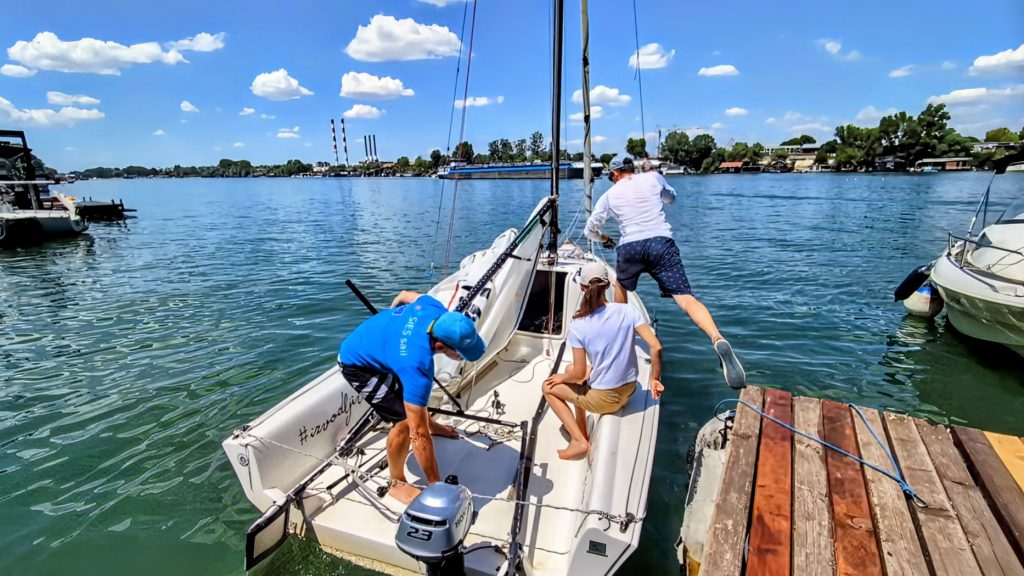
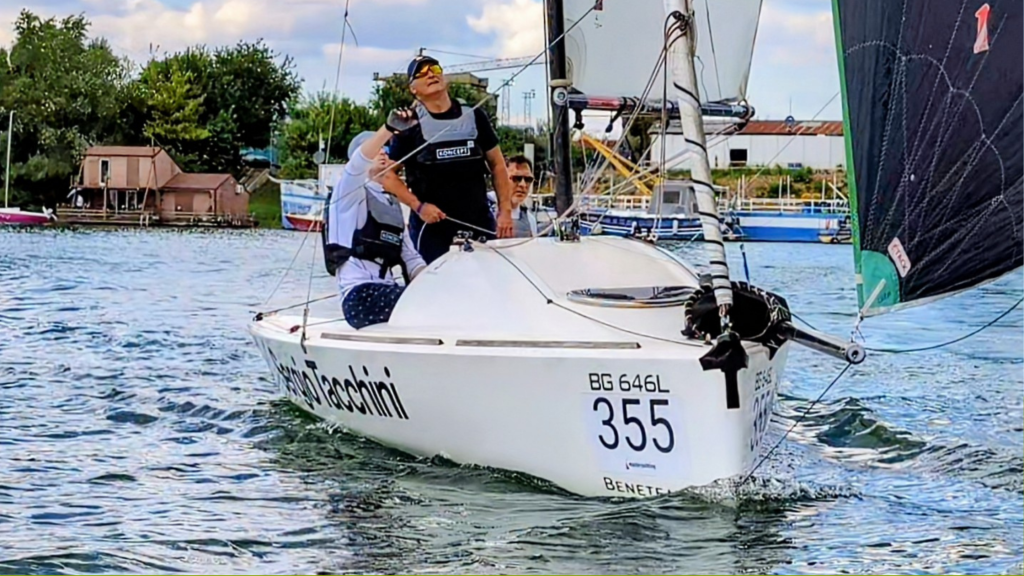
“Who among us has never stood on the shore of a lake or the sea and watched a sailing boat moving back and forth, sometimes almost into the wind, sometimes with the wind, and sometimes in another direction? When the water is calm, the boat seems to move as effortlessly as the seagulls above it.
Perhaps we have wondered how it is possible for a sailing boat to move in almost any direction while the wind continues to blow from the same direction. How can it heel so far and yet rarely capsize? And how is it possible for it to sail towards the wind at all?” (adapted from Wind, Water, Sailing and a Little Physics by Zvonko Trontelj)
Sailing is the art of using the wind to produce controlled movement through the water. Although it may appear simple, the wind fills the sails and the boat move, sailing is actually based on a carefully balanced interaction between aerodynamic forces above the water and hydrodynamic forces below it. The sails, hull, keel or centreboard, rudder, crew and surrounding water all work together to determine how fast the boat travels and in which direction. The sail is the main aerodynamic element of a sailing boat. When properly trimmed, its curved shape behaves much like an airfoil. As air flows around the sail, the sail changes the speed, direction and pressure distribution of the airflow. The pressure is generally lower on the leeward side of the sail and higher on the windward side. At the same time, the sail turns the surrounding airflow. Together, these effects produce an aerodynamic force known as lift. It is important to note that this does not occur because air travelling along the two sides of the sail has to cover different distances and meet again at the trailing edge. That common explanation is incorrect. Instead, lift results from the overall pressure distribution around the sail and the deflection of the airflow.
The aerodynamic force acting on a sail can be described using two components. Lift acts approximately perpendicular to the direction of the apparent wind, while drag acts approximately parallel to it. Drag is produced by factors such as skin friction, turbulence and airflow separation. The combination of lift and drag gives the total aerodynamic force generated by the sail. Depending on the boat’s course and the angle of the sail, part of this force drives the boat forward while another part pushes it sideways and causes the boat to heel. The wind experienced by a moving sailing boat is called the apparent wind. It is the combination of the true wind and the airflow created by the boat’s own movement through the water. Sail trim therefore depends not only on the direction and strength of the true wind but also on the boat’s speed and course. The angle between the sail and the apparent wind, known as the angle of attack, is particularly important. If the angle is too small, the sail begins to luff and produces little useful force. If it is too large, the airflow may separate from the sail and the sail can stall, increasing drag and reducing efficiency.
Because part of the force generated by the sails acts sideways, a sailing boat also needs underwater surfaces that resist sideways motion. This is primarily the function of the keel or centreboard, together with the hull and rudder. As the boat attempts to move sideways, or make leeway, water flows around these underwater surfaces and generates a hydrodynamic force in the opposite direction. Like the sail, the keel therefore acts as a type of foil. The interaction between the aerodynamic force generated by the sails and the hydrodynamic force generated below the water allows a substantial part of the available force to be converted into forward motion. This interaction is also the reason a sailing boat can travel towards the wind. A conventional sailing boat cannot sail directly into the wind because the sails cannot produce useful forward drive in that position. There is therefore a no-go zone directly upwind, typically extending roughly 35–50 degrees to either side of the true wind direction, although the exact angle depends on the type of boat, sails and conditions. To reach a destination located upwind, the boat sails at an angle to the wind and alternates between courses on opposite sides of it. This manoeuvre is known as tacking or beating to windward. By repeatedly changing tack, the boat follows a zigzag course and gradually makes progress towards its upwind destination.
Different courses relative to the wind are known as points of sail. When sailing as close to the wind as practical, the boat is close-hauled. With the wind more from the side, it is on a close reach or beam reach; with the wind coming from behind the side, it is on a broad reach; and with the wind approximately from astern, it is running. The balance between lift and drag changes considerably between these points of sail. Upwind, efficient airflow and a high lift-to-drag ratio are particularly important, whereas on deep downwind courses aerodynamic drag contributes much more directly to propulsion. A sailing boat is steered using the rudder, but effective control depends on the coordinated adjustment of both the rudder and the sails. Sheets, halyards, the mainsheet traveller, vang and other sail controls influence the tension, twist, depth and overall shape of the sails. A correctly shaped and trimmed sail maintains attached airflow over as much of its surface as possible and produces an efficient balance between lift and drag. Sail trim must therefore be continuously adapted to changes in wind strength, wind direction, sea state and the boat’s course.
The forces acting on the sails also cause the boat to heel, or lean away from the wind. This heeling moment is opposed by the boat’s righting moment. On keelboats, a major contribution comes from ballast located low in the keel, while hull shape and buoyancy also contribute to stability. On dinghies and other lightweight sailing boats, the position and weight of the crew are particularly important. As the boat heels, the balance of forces and moments changes until a new equilibrium is reached. Excessive heel is generally inefficient because it can increase drag, reduce the effectiveness of the sails and rudder, and make the boat more difficult to control. The rudder, keel and sails must therefore be considered as parts of the same system. Above the water, the sails interact with moving air; below the water, the keel, rudder and hull interact with moving water. The sails attempt to accelerate the boat both forward and sideways, while the underwater surfaces strongly resist sideways motion. The resulting balance of aerodynamic and hydrodynamic forces determines the boat’s actual direction and speed.
Sailing is thus not simply a matter of allowing the wind to push a boat. It is a continuous process of controlling airflow, water flow, forces and balance. By understanding apparent wind, aerodynamic lift and drag, hydrodynamic resistance, sail trim, stability and the relationship between the sails and the underwater surfaces, a sailor can use the available wind efficiently and guide a sailing boat safely and precisely across the water.