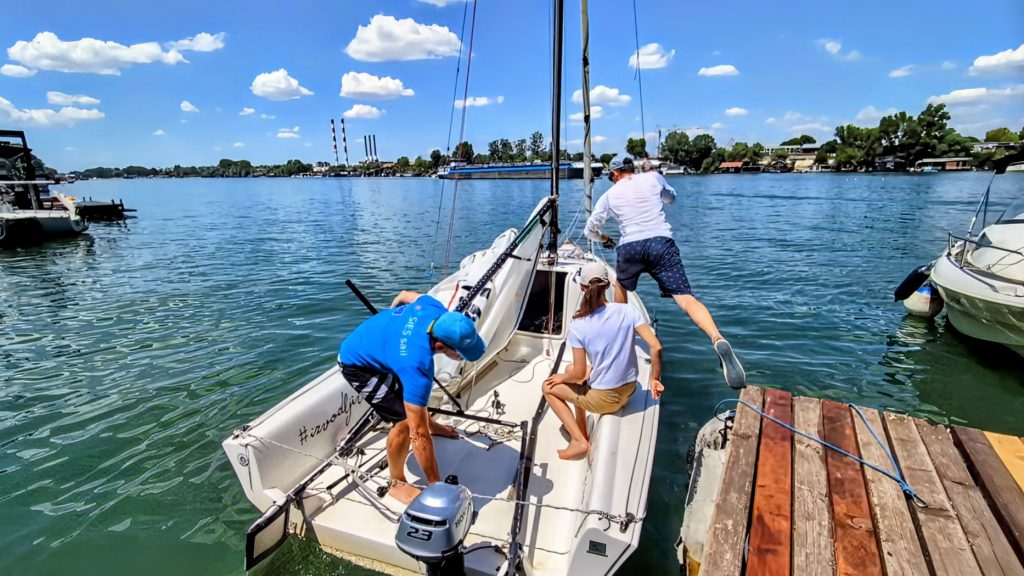
Preparing a sailboat correctly before leaving the dock is one of the most important parts of safe and efficient sailing. Rigging may seem complicated at first because there are several different systems to prepare, but with practice the process becomes logical and routine. The key is to work step by step, check each component carefully, and avoid rushing. In this lesson, the Ada Sailing Club team will show us how they prepare their boat before setting sail on the Danube.
On the Beneteau First 18, we begin with the parts of the boat that work below the waterline. The first of these is the keel. The keel plays an important role in providing stability and helping the boat maintain direction while sailing. Before sailing, it needs to be lowered into the correct position. To do this, we first release the safety pin, then lower the keel until the lifting rope becomes slack. Once the rope has loosened, we begin tightening it again until tension appears. From that point, the manufacturer recommends making three full turns upward so that the keel reaches its optimal sailing position. Once this is done, the safety pin is secured again.
After the keel is prepared, we move on to the rudders. The rudders allow us to steer and maneuver the sailboat, so they need to be installed carefully. They are relatively fragile and should never be forced or allowed to strike the boat or dock. Each rudder is placed carefully into its slot and pushed fully into position. Once both rudders are installed, the tiller extension can be attached. The tiller extension makes steering easier, especially when the sailor is hiking and needs to control the boat from a position farther away from the centerline.
The next step is to prepare the sails, beginning with the mainsail. On this boat, the mainsail is normally stored inside the cabin to protect it from prolonged exposure to sunlight. When preparing the boat, the sail is taken out and unrolled so that the head, or upper corner of the sail, can be reached easily.
Before hoisting the mainsail, we first locate the mainsail halyard. On this boat, the halyard is the line that runs from the top of the mast downward. When the boat is not sailing, the same line also serves as a topping lift and supports the boom in a horizontal position. To prepare the sail, the halyard is detached from the boom and connected to the head of the mainsail.
The Beneteau First 18 uses a 2:1 purchase on the mainsail halyard. This mechanical advantage makes the sail easier to hoist, especially when there is more wind or friction in the system. Before hoisting, it is important to make sure that the halyard is not twisted or tangled. Once everything is clear, the shackle is attached securely to the head of the sail. This connection must be properly tightened because it is the main connection holding the top of the sail in place.
As the halyard is pulled, the mainsail is guided into the mast track. The mast track keeps the sail connected to the mast and allows it to travel smoothly upward. Once the sail has been fed into the track correctly, it can be hoisted all the way to the top of the mast.
When the mainsail is fully raised, the next step is to secure the two lower corners of the sail. The front lower corner, called the tack, is attached close to the base of the mast, while the rear lower corner, called the clew, is secured at the end of the boom. On this boat, both points are secured using Velcro straps. The strap is passed through the sail and wrapped several times around the mast or boom to create a strong connection.
Once the head, tack, and clew are secured, the sail is attached at all three corners, but the preparation is not yet complete. To control the shape and power of the mainsail, several adjustment systems need to be set up.
The first is the outhaul. The outhaul controls the horizontal tension along the foot of the sail and therefore influences the depth, or draft, of the sail. A deeper sail generally produces more power, while a flatter sail produces less power and can be easier to control in stronger wind. Tightening the outhaul pulls the foot of the sail tighter and flattens its shape. Easing the outhaul allows the sail to become fuller and deeper.
Another important control is the Cunningham. The Cunningham controls vertical tension in the mainsail and helps adjust its shape. It works through a system of blocks and lines that provide mechanical advantage. By tightening or easing the Cunningham, we can increase or decrease the tension along the luff of the sail and fine-tune the sail shape according to the conditions.
The third important system is the vang. The vang is the diagonal control that connects the boom to the lower part of the mast area. Its purpose is to prevent the boom from rising when the wind increases or when the mainsheet is eased. By tightening the vang, we help keep the boom lower and maintain better control over the sail shape.
Once the mainsail has been fully prepared, the jib can be made ready. On the Beneteau First 18, the jib is fitted with a furling system, which makes preparation very quick. Instead of raising the foresail manually each time, the sail is stored rolled around the forestay. To unfurl it, we release the furling line and pull on the leeward jib sheet. The sail then unrolls and is ready for use within a few seconds.
Rigging a sailboat becomes easier with repetition. In the beginning, the process may take more time, and it is normal to make small mistakes or need to check the sequence more than once. The important thing is to work calmly and carefully. Correct preparation has a direct effect on safety, performance, and how easy the boat will be to control once underway.
A well-rigged sailboat should have its underwater components properly positioned, its steering system securely installed, its sails correctly attached, and all adjustment systems ready to use. Taking the time to prepare the boat properly makes the sailing itself more enjoyable and helps prevent problems once you are on the water.
With practice, rigging becomes a natural part of the sailing routine and provides a good opportunity to become familiar with the boat and its systems before setting sail.