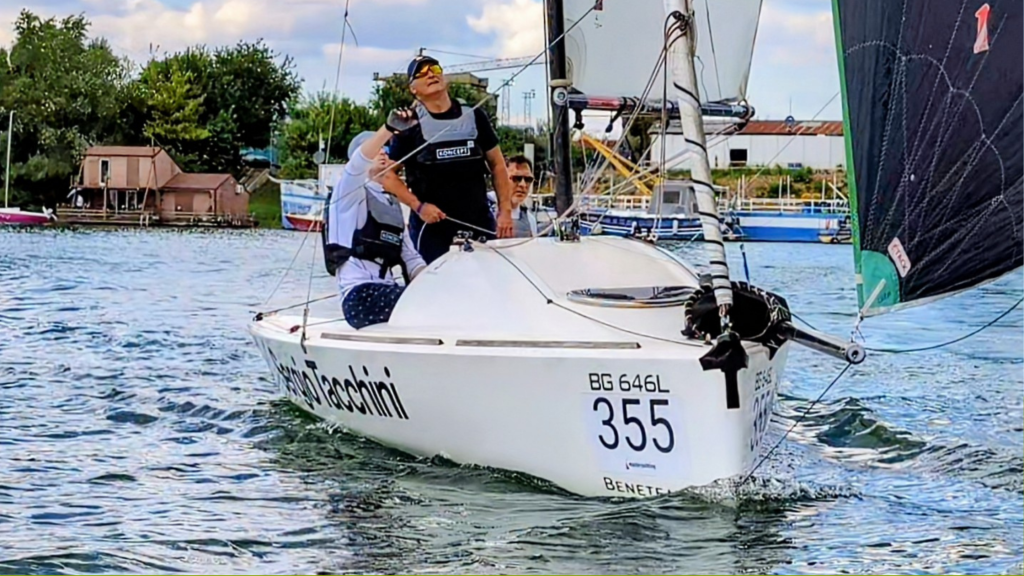
Packing up the sailboat may not be as exciting as sailing itself, but it is an important part of every sailing session. Properly stowing the sails, ropes, steering equipment, and underwater components helps protect the boat, keeps the equipment organized, and significantly extends its lifespan. Taking a few extra minutes after sailing can prevent unnecessary wear, damage, and problems the next time the boat is used. In this lesson, the Ada Sailing Club team will show us how they pack up their boat after sailing on the Danube.
The first step is to lower the mainsail. We begin by uncleating the mainsail halyard and then carefully pulling the sail down by hand into the cockpit. Once the sail is completely lowered, all three corners need to be released: the head, where the halyard is attached, the clew at the end of the boom, and the tack at the mast. It is also important not to forget the other systems connected to the sail, especially the outhaul and the Cunningham. These lines should be secured properly after being disconnected, particularly the outhaul, so that the line cannot accidentally disappear inside the boom.
Once the mainsail is completely free, it can be prepared for storage. Instead of folding the sail, it is better to roll it. Folding repeatedly in the same places creates creases in the sailcloth and can shorten the life of the sail. Rolling helps preserve its shape and keeps the material in better condition for longer. On the Beneteau First 18, which uses a full-batten mainsail, it is practical to begin at the top of the sail and roll it toward yourself. The battens help the sail keep its shape, making the process relatively easy even when working alone.
It is also important to remember that water and moisture are not the only things that damage sailing equipment. Sunlight, especially prolonged exposure to UV radiation, can weaken sailcloth, ropes, rubber components, and other materials. For this reason, the mainsail should be moved out of direct sunlight as soon as possible after sailing. Once rolled, it can be stored safely inside the cabin.
With the mainsail removed, the boom should also be secured. On this boat, the mainsail halyard is used to support the boom when the sail is not in use. The halyard is attached to the outhaul area and tensioned together with the mainsheet. When done correctly, the boom is held securely and cannot move excessively up, down, or from side to side.
The jib requires a slightly different approach because it remains furled around the forestay. Although the sail is rolled up, it still needs protection from the sun. A jib cover is therefore hoisted over it using the spinnaker halyard. The upper part of the cover is first positioned above the jib sheet, the spinnaker halyard is attached to the cover, and the cover is then raised to the top of the jib while the zipper is closed. Once in place, the jib is protected from direct sunlight while the boat is not in use.
After the sails have been taken care of, attention can move to the ropes and deck equipment. Electronic instruments, such as a racing computer, should be switched off, removed, and stored somewhere safe if the boat is not going to be used. The jib sheet, spinnaker sheet, mainsheet, and other working lines should be collected and stored neatly in their designated places.
If the boat has rope bags, the lines can be placed inside them. If not, it is often better to hang the ropes rather than leaving them lying on the deck. Hanging allows them to dry more quickly if they become wet and prevents water from remaining trapped between the rope and the deck surface. This helps protect both the rope and the material underneath it.
The tiller extension should also be removed and stored out of the sun. The rubber joint that connects the extension to the tiller is a small but important component, and prolonged UV exposure can make rubber brittle and shorten its service life. Protecting such small parts is just as important as looking after the larger pieces of equipment.
Once the deck and cockpit are organized, we can move on to the underwater components. The rudder blades are removed carefully from their slots using the rope handles and placed in protective bags. Rudders are relatively delicate and should always be handled carefully to avoid scratches, impacts, or other damage during storage.
The keel is raised last. There is a good reason for this order: while the boat is being packed, the lowered keel continues to provide stability, making it easier and safer to move around on board. Only once the rest of the boat has been organized do we raise it.
To lift the keel on the Beneteau First 18, the safety pin is first moved into the correct position for raising. The winch handle is then turned until the keel is fully lifted, which in this case takes approximately twenty turns. Once the keel is completely up, the safety pin is returned to its locking position so that the keel cannot drop back down.
Packing up properly is not simply about keeping the boat tidy. It has a direct effect on the durability, reliability, and performance of the equipment. Sails that are protected from creases and sunlight, ropes that can dry properly, and fragile parts that are stored safely will remain in good condition for much longer.
Just like rigging the boat before sailing, packing it up becomes faster and easier with practice. A good routine helps ensure that nothing is forgotten and that the boat is ready for the next sailing session.
Taking care of the boat after sailing is part of being a responsible sailor. The better we care for the equipment today, the more reliable it will be the next time we head out on the water.