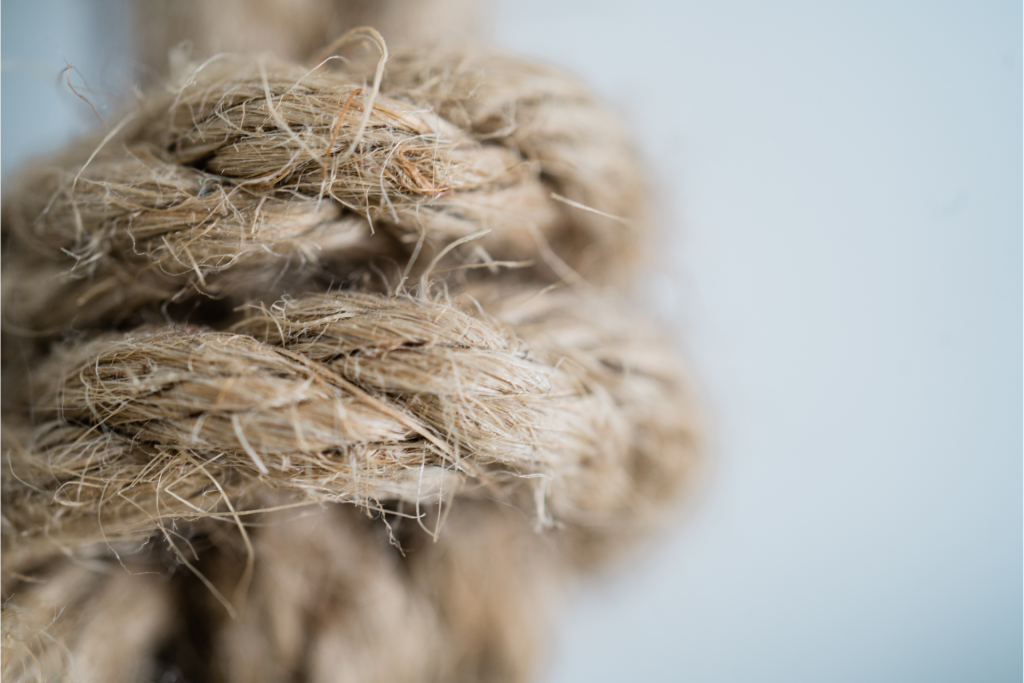
Ropes are an indispensable part of every vessel, as they are used in almost all tasks on a sailboat, from anchoring and mooring to hoisting and trimming sails. Depending on their intended use, ropes must be sufficiently strong, flexible, and reliable, while also being suited to marine conditions.
We distinguish between ropes made from natural fibers, such as flax, hemp, and manila, and ropes made from synthetic materials, the most common of which are polyamide (nylon), polyester (Dacron), aramid (Kevlar), and polyethylene (Spectra). Synthetic ropes are more widespread today because they are more resistant to moisture, abrasion, and UV radiation, and some are also characterized by low stretch and light weight. Steel wire ropes also have a special role, being used where very high load-bearing capacity is required.
According to their construction, ropes can be divided into braided and twisted ropes. Braided ropes may have a core or be coreless, and their main advantages are high flexibility and low stretch. Because of these properties, they are suitable for sail halyards, flag lines, and sail trimming. Twisted ropes are more stretchable and elastic, so they are most commonly used for anchoring and mooring the boat. They are usually made of three strands twisted either to the left or to the right.
An important aspect of handling ropes is the use of knots, which are used to secure or connect ropes safely. From most ropes, except steel wire ropes, various knots can be made, adapted to specific tasks. On a sailboat, the most commonly used knots are the overhand knot, flag knot, clove hitch, anchor knot, sheet bend, bollard hitch, figure-eight knot, and bowline. These knots are well tested and reliable, allowing quick tying and easy untying, even after heavy loads.
Good knowledge of rope types, their correct use, and basic knots is an important part of every sailor’s skill set.