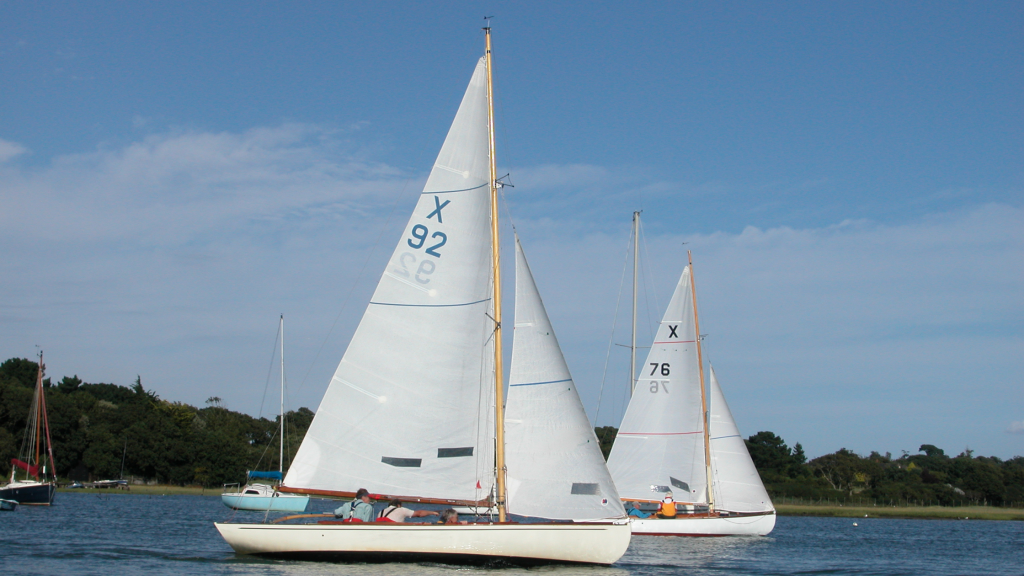
Jibing is a maneuver used when sailing downwind or on a broad reach, in which the aim is to change the side from which the wind acts on the sails. It is a more technically demanding and dynamic maneuver than tacking, as it involves the rapid movement of the mainsail from one side of the boat to the other. For this reason, it requires greater concentration, precise handling of the sheets, and good coordination of the crew in order to be carried out safely and under control.
The maneuver begins from stable sailing on a broad reach, when the sailboat has a steady speed and the sails are correctly trimmed. Before starting, the helmsman must check the conditions, especially wind strength and crew readiness, and announce the jibe in good time so that all crew members can prepare for their tasks. During a jibe, both the mainsail and the headsail must be shifted at the same time, which requires more coordination than a tack.
Special attention must be paid to the mainsail, as it is under wind load for almost the entire maneuver. Only for a brief moment, when the boat crosses the wind direction, does the wind shift to the opposite side, causing the boom to swing across. This movement is unavoidable, but it must be kept as short and controlled as possible. Therefore, during the jibe the mainsheet is gradually trimmed in as much as possible to reduce the speed and force of the boom’s swing. Once the mainsail crosses to the other side and begins to fill with wind from the new direction, the mainsheet is eased in a controlled manner until the sail reaches its correct working trim.
The jib is also transferred to the opposite side of the boat during the jibe. This means that at the appropriate moment one jib sheet is released while the other is trimmed in. This part of the maneuver is usually less critical, but it must be done at the right time so that the sail passes smoothly across the bow and quickly fills again. Proper handling of the jib helps the boat maintain stability and speed throughout the maneuver.
Because both sails must be handled simultaneously, jibing is generally not suitable to be performed single-handed without crew assistance. Even when using an autopilot, at least two people are required for a safe maneuver, and it is even better if the tasks are clearly divided among several crew members. Typically, the helmsman steers the boat through the jibe, one crew member focuses exclusively on the mainsheet, while one or two others handle the releasing and trimming of the jib sheets. Such a division of labor provides better control, increased safety, and reduced strain on individuals.
When conditions are unfavorable, or when the crew is not sufficiently numerous or experienced, a jibe is often replaced by a series of tacks. Although this results in a larger turn of the boat, such a maneuver is generally safer, as it avoids the rapid and forceful swing of the boom. This approach is especially recommended in stronger winds or when the boat is handled by a single person, as it significantly reduces the risk of injury and damage to equipment.