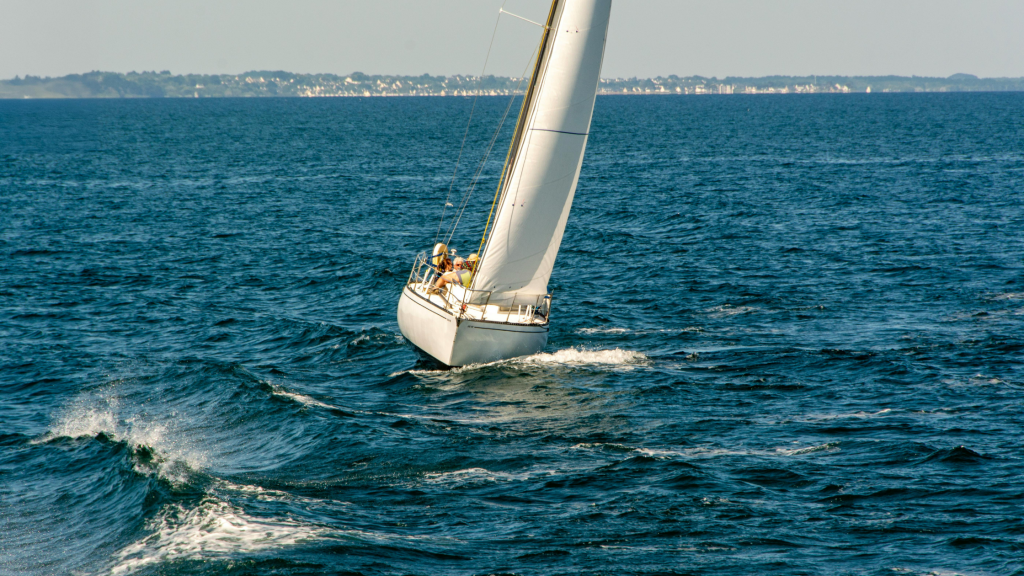
A sailboat is made up of several carefully designed parts that work together to allow safe and efficient sailing. Understanding basic sailing terminology is important not only for learning how to sail, but especially for safety, good teamwork, and confident handling of the boat, particularly in difficult and unpredictable sea conditions.
Before the skipper leaves the harbor, they must clearly know the names of all main parts of the boat and its equipment and explain them to the crew. This helps avoid misunderstandings that could delay help in critical situations. Clear and consistent communication is essential for safety at sea.
Every sailboat consists of several groups of components. To better understand the whole boat, we divide these into main structural parts, general boat equipment, and special sailing equipment used mainly on sailboats.
Main Parts of the Boat
- Hull is the most important part of any boat, as it provides buoyancy and keeps the boat floating. All other parts are built onto it. It supports the crew, cargo, and all equipment needed for safe sailing. On sailboats, the mast and keel are firmly attached to the hull because they carry very high loads. The shape, weight, and materials of the hull strongly affect performance, such as maximum speed (hull speed), acceleration, maneuverability, and stability.
- Keel is the main underwater and strongest structural part of a sailboat. It allows the boat to sail upwind and plays a key role in directional stability and reducing heel (leaning). A heavier keel or one with ballast increases stability and helps prevent excessive heeling
- Rudder is the main steering device of a sailboat. It controls and changes the direction of travel. The steering system includes the rudder blade, rudder shaft, and a control system, which can be a tiller or a steering wheel.
- Deck is the walkable upper surface of the boat that closes the hull from above. Important equipment such as winches, cleats, and entrances to the interior are located here. It also allows the crew to move safely while sailing.
- Cockpit is the area from which the boat is controlled. It contains the steering system, navigation instruments, and sail controls. It often also serves as an outdoor living and social space.
- Cabin is the enclosed living area inside the boat, intended for rest and accommodation of the crew.
- Bow is the front part of the sailboat and is the first to meet the water. Its shape greatly affects speed, wave handling, and how smoothly the boat moves through the water.
- Stern is the rear part of the sailboat. The rudder, steering system, and often the auxiliary engine are located here. The stern is important for stability and maneuvering.
Basic Boat Equipment
- Cleats, fairleads, cam cleats, rope clutches, and stoppers are used to secure, guide, and hold ropes on board. While they have a similar purpose, they differ in shape, size, and use. Cleats are strong fittings for tying lines. Fairleads guide ropes and reduce chafing. Smaller cleats are often used for temporary fastening. Rope clutches and stoppers allow quick tightening and releasing of lines and are especially important for sail control.
- Anchor is essential for keeping the boat safely in one place when it is not tied up. There are many types of anchors, such as Danforth, claw, and admiralty anchors, each designed for different seabeds like sand, mud, or rock. The right anchor choice ensures the safety of the boat and crew.
- Anchor windlass is a mechanical device used to raise and lower the anchor, especially on larger and heavier boats. It can be electric or hydraulic and is usually mounted at the bow. It reduces physical effort and increases safety by allowing controlled handling of the anchor and chain or rope.
- Propeller provides engine-driven propulsion. Its size, shape, and pitch affect efficiency, speed, and fuel consumption. Propellers can rotate clockwise or counterclockwise, which influences maneuvering, especially when reversing and docking.
- Mooring lines / docking lines are used to secure the boat to a dock, buoy, or another vessel. They are made of strong and slightly elastic materials to absorb shocks from wind and waves.
- Fenders are plastic or rubber buffers that protect the hull from impacts with docks or other boats. They are placed along the sides and are especially important during docking and when the boat is stationary.
- Boat hook is a long pole with a hook at the end, used to pick up lines, buoys, or objects from the water.
Sailing Equipment
- Mast is the main vertical support of a sailboat. Sails, rigging, and most running lines are attached to it. It is usually made of aluminum or carbon fiber, less often wood. The mast carries strong wind and rope loads and must be properly secured and balanced.
- Standing rigging (shrouds and stays) are steel cables or rods that support and stabilize the mast. Shrouds prevent sideways movement, while stays (forestay and backstay) prevent forward and backward movement. Correct tension is essential for safety and good sail shape.
- Boom is a horizontal spar attached to the mast that supports the lower edge of the mainsail. It allows control of sail angle and shape using sheets, the vang, and other controls. Because it moves, the boom can be dangerous and requires attention from the crew.
- Halyards are lines used to raise and lower sails. The most common are the mainsail halyard and the jib or genoa halyard. Their tension affects sail height and shape.
- Mainsheet controls the angle and tension of the mainsail. It is attached to the end of the boom and usually runs through a system of blocks to a winch or handhold in the cockpit. This system allows control of large forces with less effort.
- Jib sheets control the position and angle of the jib. There are usually two sheets, one on each side, allowing easy sail handling when changing tack. The sheet runs from the sail through blocks and fairleads to a winch in the cockpit.
- Winch is a mechanical device used to tighten lines under high loads. It greatly increases pulling force and is essential for larger sails or strong winds. Winches can be manual or electric.
- Winch handle is a removable lever inserted into a winch to turn it. It allows high line tension with minimal effort. Proper use and storage are important for safety.
- Mainsail is the primary sail of a sailboat, set between the mast and the boom. It has a major influence on speed, direction, and stability. Its shape is adjusted using various controls such as the halyard, sheet, vang, and sliders.
- Headsail (jib) is set on the forestay at the front of the boat. It provides important drive, especially when sailing upwind or on a reach. It is smaller than a genoa and easier to handle.
- Spinnaker is a large, balloon-shaped sail used when sailing downwind. It provides high speed but requires good coordination and experience to handle safely.
- Gennaker is a combination of a genoa and a spinnaker. It works well from slightly upwind to downwind and is easier to use than a traditional spinnaker, making it very popular on modern cruising and racing boats.
- Boom vang is a system of blocks or hydraulics between the mast and boom. It pulls the boom downward to control the shape of the mainsail, especially in stronger winds or when sailing downwind.
Spinnaker pole is an additional spar used with a spinnaker or genoa. It helps spread the sail and keep a stable shape, especially when sailing with side or following winds.