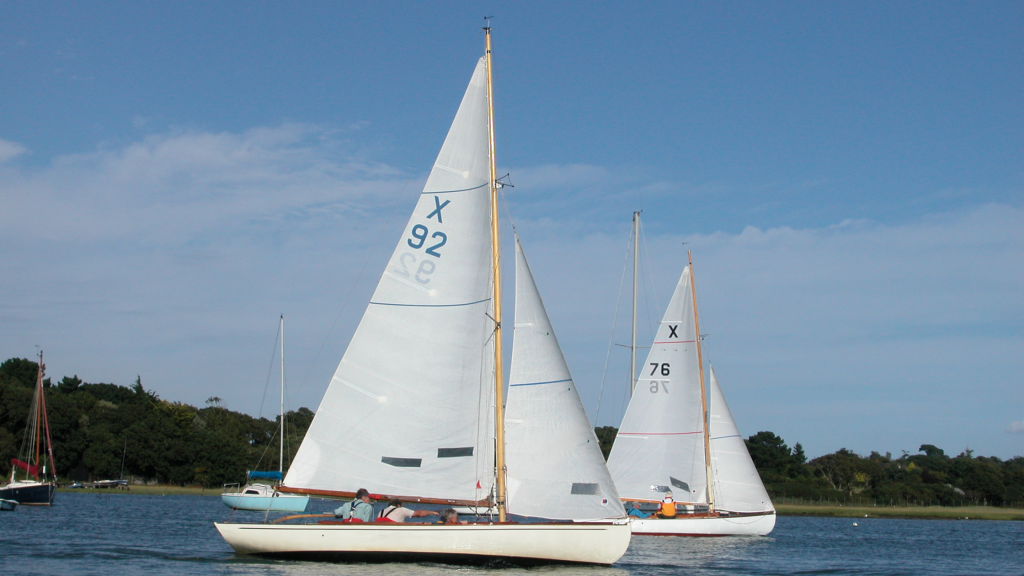
Raising or hoisting the mainsail is carried out in an open and safe area, usually outside the harbor, where the sailboat has enough room to maneuver and where there is no risk of collision Before starting, the helmsman makes sure that the boat is sufficiently far from the shore and any obstacles, then, at moderate speed and with the help of the engine, steers the boat directly into the wind. Sailing in this direction is essential, as it reduces wind pressure on the sail and allows the process to be calm, controlled, and safe. Throughout the entire procedure, the engine remains running so the helmsman can maintain a steady course and speed.
Before the sail is raised, the crew must be familiar with the boat’s equipment, the types of sails, and how they are attached and handled. Most modern sailboats are equipped with a Bermuda mainsail, which is triangular in shape and attached to the mast and the boom. In the traditional system, the luff of the sail is attached to the mast with slides, while the foot runs along a track in the boom. On many cruising sailboats, an in-mast furling mainsail system is increasingly common, where the sail is already hoisted and rolled inside the mast and is ready to be unfurled when needed. In this case, the clew of the sail is connected to the outhaul line, which runs over a sheave at the end of the boom, through the boom, toward the mast, and then to the deck and a stopper. While the sail is not yet hoisted, the boom is usually supported by a rigid vang or a topping lift, which relieves its weight.
Before raising, the crew fully prepares the sail. All sail ties are untied or the lazy bag or lazy jack system is opened, and it is checked that the halyard (or the outhaul line in the case of a furling mainsail) is correctly led, free of knots and tangles, and properly attached to the mainsail. At the same time, with a traditional mainsail, the crew ensures that the slides or battens are correctly inserted into the mast track. The mainsheet must be completely released so that the boom can move freely, and it is also necessary to check that any reefing lines, if set, are eased before hoisting a conventional sail.
Before starting the hoist, the helmsman assigns tasks to the crew. Usually, at least three crew members are needed:
- the helmsman, who ensures precise steering into the wind,
- the person hoisting the mainsail, who operates the halyard or outhaul line,
- and the mainsail trimmer, who is positioned at the mainsheet.
When the helmsman judges that the sailboat is sailing steadily and safely straight into the wind, he or she orders the start of the procedure.
The person hoisting the sail begins to pull the halyard steadily and smoothly, usually using a deck winch, while the helmsman maintains a course directly into the wind. If there are enough crew members, one person at the mast can assist by pulling the same halyard by hand and ensuring that the sail does not get stuck. During hoisting, the run of the lines and the sail must be constantly monitored. If significant resistance occurs, the hoist is immediately paused and possible obstructions are checked, such as tangles around shrouds, reefing lines, or lazy jack lines. When the sail is almost fully hoisted, the winch is usually used for final tensioning, after which the halyard is secured in the stopper and properly tightened so that the sail is correctly tensioned along the luff.
With an in-mast furling mainsail, the procedure is very similar, except that the sail is not hoisted but unfurled from the mast. Before starting, the lock of the furling mechanism on the mast is released, and the sail is then evenly pulled out using the outhaul line in the boom. In this case as well, it is important that the sailboat is steered precisely into the wind and that the sail is unfurled smoothly, without jerks or tangles. The procedure is complete when the sail is fully unfurled and properly tensioned.
Once the mainsail has been successfully hoisted or unfurled, the helmsman bears the bow slightly away from the wind so that the sail fills. At the same time, the trimmer sheets in the mainsheet appropriately and sets the sail roughly. In stronger winds, it is advisable to tension the sail more or, if necessary, reef it before or immediately after hoisting, while in lighter winds it is left slightly looser to maintain an optimal shape and make more efficient use of the wind. When the sailboat is sailing steadily and the sail is correctly trimmed, the helmsman switches off the engine and continues sailing in the desired direction.