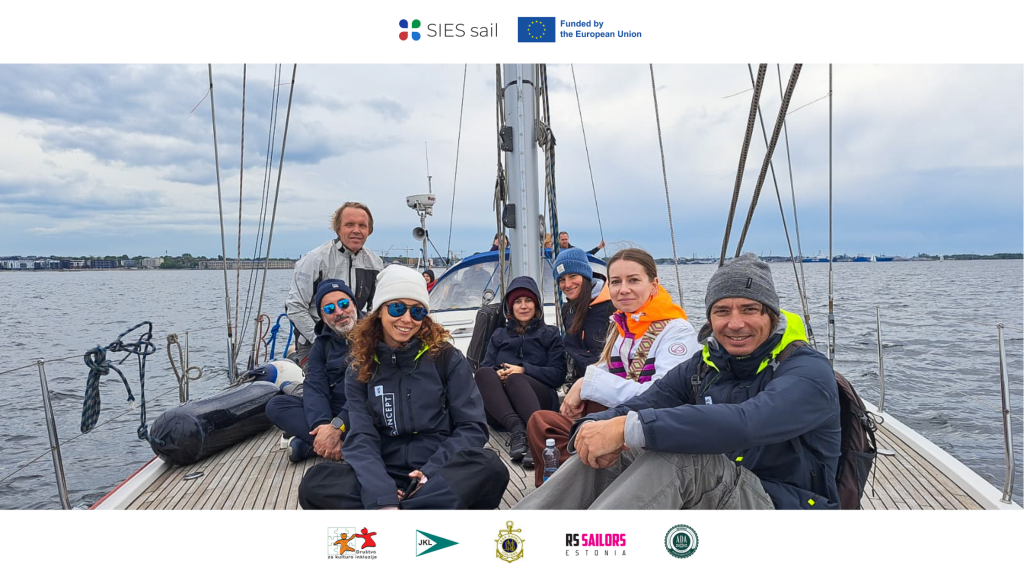
From May 29 to June 1, 2025, the third international SIESsail meeting took place in Tallinn, hosted by RS Purjetajate Liit at the Olympic marina in Pirita. The meeting brought together partners from Slovenia, Italy, Estonia, and Serbia to exchange best practices, strengthen collaboration, and explore new approaches to inclusive and accessible sailing.
Connecting tradition with modern approaches
The program began with an introduction to Estonia’s sailing tradition and a visit to the renowned Kalev Yacht Club, one of the country’s most important sailing centers. Participants were also impressed by the modern architecture of the new building, which incorporates old sails from members as a symbolic tribute to history and community. One particularly interesting initiative was the Meresõber (Friend of the Sea) project – a mobile sailing school in a container that travels across Estonia, bringing sailing experiences to children and adults even in places without sailing clubs. It’s a great example of how innovative approaches can expand access to sport.
Maritime heritage and inclusion
Participants also visited the Seaplane Harbour Maritime Museum, one of Europe’s most iconic maritime museums. In addition to its impressive collection of ships, submarines, and seaplanes, they learned about ice sailing – a northern specialty where vessels reach remarkable speeds on frozen surfaces. The meeting also included sailing on a yacht, giving participants a first-hand experience of Baltic sailing culture. A strong focus of the Estonian meeting was inclusion. The Special Sailors program (Erilised Purjetajad) was presented, offering sailing opportunities to people with diverse needs – from children to seniors. The club uses adapted boats such as Hansa 303 and RS Venture, along with specialized equipment that enables safe access even for wheelchair users. Importantly, the program includes not only people with physical disabilities but also individuals facing social and psychological challenges. Sailing thus becomes a space for inclusion, confidence-building, and community connection.
Another key topic was the role of young people in sailing. Participants attended a regatta and followed RS Aero class races in the challenging conditions of the Baltic Sea. This provided insight into the transition from recreational to competitive sailing and the challenges faced by young sailors and coaches.
Discussions also addressed how to keep young people engaged in the sport long-term, reduce competitive pressure, and involve families in sailing activities. Many good practices were shared, including examples from Slovenia.
The SIESsail project continues its journey in Belgrade.